The moment a tenancy ends and the keys are handed back, the question that preoccupies most outgoing tenants is the same: how much of the deposit is actually coming back? In London’s private rental market, where deposits on a typical two-bedroom flat in areas like Belsize Park or Hampstead can run to several thousand pounds, that question carries considerable financial weight. Cleaning is, consistently, the single most common reason for deposit deductions – and also the most contested. Understanding what the deposit protection schemes actually permit landlords to deduct, what standard of evidence is required, and where the boundaries of legitimate deduction lie is not merely useful. For any tenant approaching the end of a London tenancy in 2026, it is essential.
How Deposit Protection Works in England in 2026
The Three Government-Backed Schemes
Since 2007, landlords in England have been legally required to protect tenants’ deposits in one of three government-authorised schemes: the Deposit Protection Service (DPS), the Tenancy Deposit Scheme (TDS), and MyDeposits. Each operates slightly differently – the DPS and MyDeposits both offer custodial and insured options, while the TDS functions primarily on an insured basis in the private rental sector – but all three follow the same adjudication principles when a dispute is raised. The process is free for tenants to initiate. If a landlord and tenant cannot reach agreement on the amount to be returned at the end of a tenancy, either party can submit a formal dispute and present their evidence to an independent adjudicator, whose decision is binding on both sides.
How Disputes Are Raised and Adjudicated
Adjudication is an entirely documentary process. There are no hearings, no site visits and no telephone conversations. The adjudicator reviews the evidence submitted by both parties – typically the check-in inventory, the check-out report, dated photographs, cleaning invoices and any relevant written communications – and reaches a decision based solely on what that evidence demonstrates. This is a point that many tenants do not fully appreciate until they are already in a dispute: the strength of your position is determined entirely by the quality of your documentation, not by what you remember or what you consider to be fair.
What Counts as a Legitimate Cleaning Deduction
The Evidence Standard Adjudicators Apply
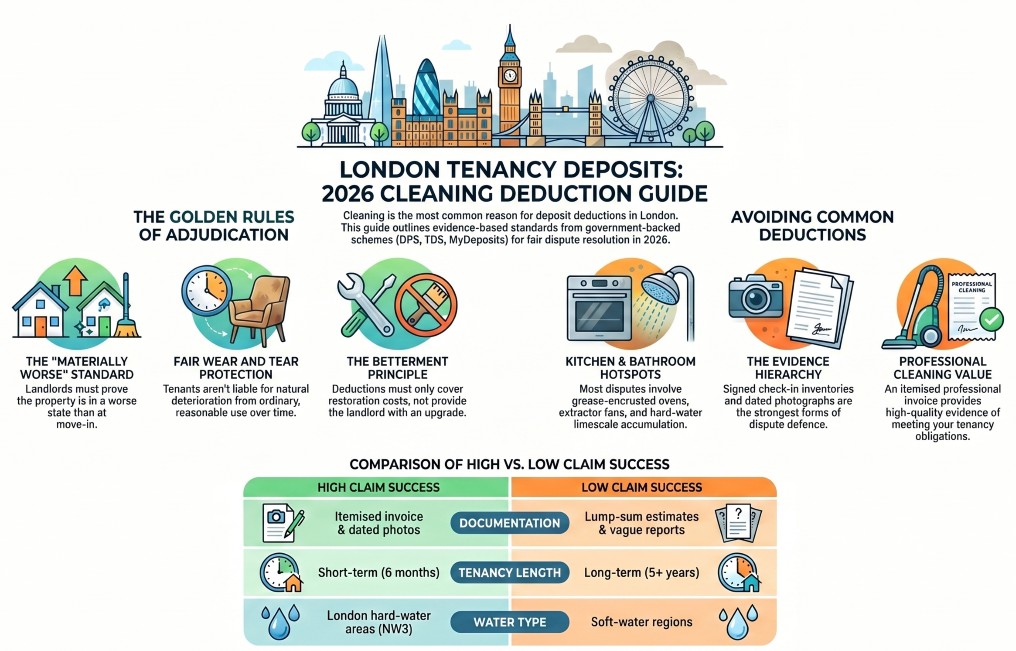
For a landlord to make a successful cleaning deduction through any of the three schemes, they must demonstrate two things: that the property was provided in a clean condition at the start of the tenancy, and that it was returned in a materially worse state at the end. The check-in inventory is the primary instrument for establishing the first point. A detailed, signed inventory with dated photographs showing a professionally cleaned property at move-in sets a clear and defensible baseline. Without it – or with a vague one – the landlord’s position in any dispute is significantly weakened. Adjudicators apply a balance of probabilities standard: they are asking whether the evidence makes it more likely than not that the property was left in a worse condition than it was received.
The Difference Between Cleaning and Damage
The schemes draw a clear distinction between cleaning and damage, and that distinction matters because the two are treated differently. Cleaning is the removal of dirt, grease and biological matter to restore a surface to its prior condition. Damage is a physical alteration to the fabric of the property – a burnt hob, a cracked tile, a stained carpet that cannot be restored by any cleaning method. A landlord may legitimately claim for both in the same dispute, but the two must be itemised separately, costed in proportion to the specific defect, and supported by distinct evidence. Conflating them – or submitting a single invoice that bundles cleaning and remedial works without itemisation – is one of the most consistent reasons landlords receive only partial awards.
Fair Wear and Tear – The Rule That Protects Tenants
What Fair Wear and Tear Actually Means in Practice
Fair wear and tear is the principle that protects tenants from being charged for the natural deterioration that occurs through ordinary, reasonable use of a property. It is not a vague concession – it is a well-established legal concept that adjudicators apply consistently and without sentiment. A kitchen that was professionally cleaned at the start of a three-year tenancy will not be in the same condition three years later even if the tenant cleaned it regularly throughout. Some discolouration of grouting, some dulling of worktop surfaces and minor marks on painted woodwork are the inevitable result of normal habitation, and deductions for these will not be upheld. What is permissible is a deduction for cleaning that goes materially beyond what fair use would produce: a heavily grease-encrusted oven, mould-blackened silicone neglected for the duration of the tenancy, or window frames and tracks that have received no cleaning since move-in.
How Length of Tenancy Affects the Calculation
The longer the tenancy, the greater the latitude adjudicators allow for natural deterioration – and the harder it becomes for a landlord to sustain a full cleaning deduction. A six-month tenancy carries a very different wear and tear allowance than a five-year one. In practice, adjudicators frequently apply a proportional reduction to claimed amounts in longer tenancies, reflecting the understanding that a landlord cannot reasonably expect a property returned to move-in condition after years of ordinary occupation. Where awarding the full claimed amount would leave the landlord with a property in better condition than it was at the start of the tenancy – newer-looking, effectively – the award will be reduced to reflect that benefit. This is sometimes referred to informally as the betterment principle, and it applies to cleaning claims just as it does to repair or replacement.
The Most Common Cleaning Deductions in London Rental Properties
Kitchens and Bathrooms – Where Most Disputes Originate
In London’s rental stock – from the large period conversions of NW3 to the purpose-built flats that line much of Zone 2 – kitchens and bathrooms generate the majority of end of tenancy cleaning disputes. In kitchens, the most frequently contested items are ovens, extractor fans and hobs. Oven cleaning is a particularly common flashpoint because the standard required is specific: the interior must be free of grease, carbonised residue and odour. An oven that has been wiped but not properly degreased will fail a check-out inspection in most London properties managed by ARLA-regulated agents. Extractor fan filters, which accumulate grease silently over months and years, are a routine oversight. In bathrooms, limescale accumulation on shower screens, taps and tiles is the dominant issue – particularly in London’s hard water areas, which include NW3 and most of the city north of the river.
Windows, Carpets and Specialist Cleaning Charges
Windows generate a growing share of deposit disputes, for the reasons this blog has explored elsewhere: frames, sills and tracks are assessed as distinct items from glass, and each component must meet the standard documented at check-in. Carpets present their own set of questions. Professional steam cleaning is routinely stipulated in London tenancy agreements, and adjudicators will generally uphold a deduction if the check-in inventory confirms the carpets were professionally cleaned at the start and the check-out report shows they were not. Where specialist charges arise – antifungal treatment for mould growth, biological cleaning following pet occupation, or deep cleaning of upholstered furnishings included in the let – adjudicators require clear evidence that the requirement was caused by the tenant’s use of the property rather than by conditions that predated the tenancy.
How Landlords Must Calculate Cleaning Costs
Proportional Deductions and the Betterment Principle
Cleaning deductions must reflect the actual cost of restoring the property to the condition documented at the start of the tenancy, adjusted for fair wear and tear. They cannot be used as an opportunity to upgrade. If carpets were mid-range and several years old at move-in and require professional cleaning at move-out, the deduction must cover the cost of that cleaning – not the cost of new carpets. Where cleaning genuinely cannot restore a surface because the deterioration is physical rather than superficial, replacement costs may be considered, but always subject to age, condition and betterment adjustment. Adjudicators are experienced in identifying claims that use cleaning charges as a vehicle for improvement rather than restoration, and they reduce awards accordingly.
Receipts, Invoices and Professional Quotations
Any claimed amount must be supported by documentary evidence. An itemised invoice from a cleaning company, dated after the check-out inspection and consistent with the specific deficiencies identified in the check-out report, is the strongest form of evidence a landlord can submit. A professional quotation is acceptable where the tenant disputes that the work was carried out, but adjudicators will examine the relationship between the quotation and the documented defects carefully. Lump-sum estimates without itemisation, invoices that predate the check-out inspection, or charges that bear no logical relationship to the scale of the defect are all common grounds for a reduced or zero award.
Protecting Your Deposit: Documentation and Professional Cleaning
The Check-In Inventory as Your Strongest Defence
For tenants, the most reliable protection against unjustified cleaning deductions is a thorough, signed check-in inventory. If the property was not presented in a professionally clean condition at the start of the tenancy – or if the inventory is vague, unsigned or undated – the landlord’s ability to claim cleaning costs at the end is substantially curtailed. Tenants should review the check-in inventory on arrival, annotate any discrepancies in writing, and retain a signed copy throughout the tenancy. Photographs taken on the first day of occupation, stored with a verifiable date and timestamp, add a further layer of documentary protection that adjudicators take seriously.
Professional End of Tenancy Cleaning and Its Evidential Value
A professional end of tenancy clean, conducted to a documented standard and supported by an invoice, significantly reduces the likelihood of a successful cleaning deduction. It demonstrates that the tenant discharged their obligations properly, creates a clear evidential record when placed alongside the check-in inventory, and removes the most frequent grounds for a dispute to be raised in the first place. For tenants in higher-value rentals – as is typical across Belsize Park and the surrounding NW3 postcodes, where asking rents and therefore deposit amounts sit well above the London median – the cost of professional cleaning represents a straightforward and well-proportioned protection against a potentially far larger claim.
The rules governing cleaning-related deposit deductions in 2026 are, in principle, consistently framed and consistently applied across all three government-backed schemes. Deductions must be evidenced, proportionate, adjusted for fair wear and tear, and confined to the cost of restoration rather than improvement. In practice, the outcome of any individual dispute turns almost entirely on the quality of documentation held by each party – and in London’s competitive rental market, where deposits are substantial and agents are thorough, that documentation begins on the very first day of the tenancy.